
Perceptual Positioning: The Trading Psychology of Reading One Chart From Three Seats
Perceptual Positioning is seeing the same chart from three seats: the retail trader, the market maker, and the observer who sees the whole trap. It is where Forexia starts on trading psychology: before you ask how you feel about a trade, ask whose seat you are reading it from. "We don't move with the herd. We move with what moves the herd."
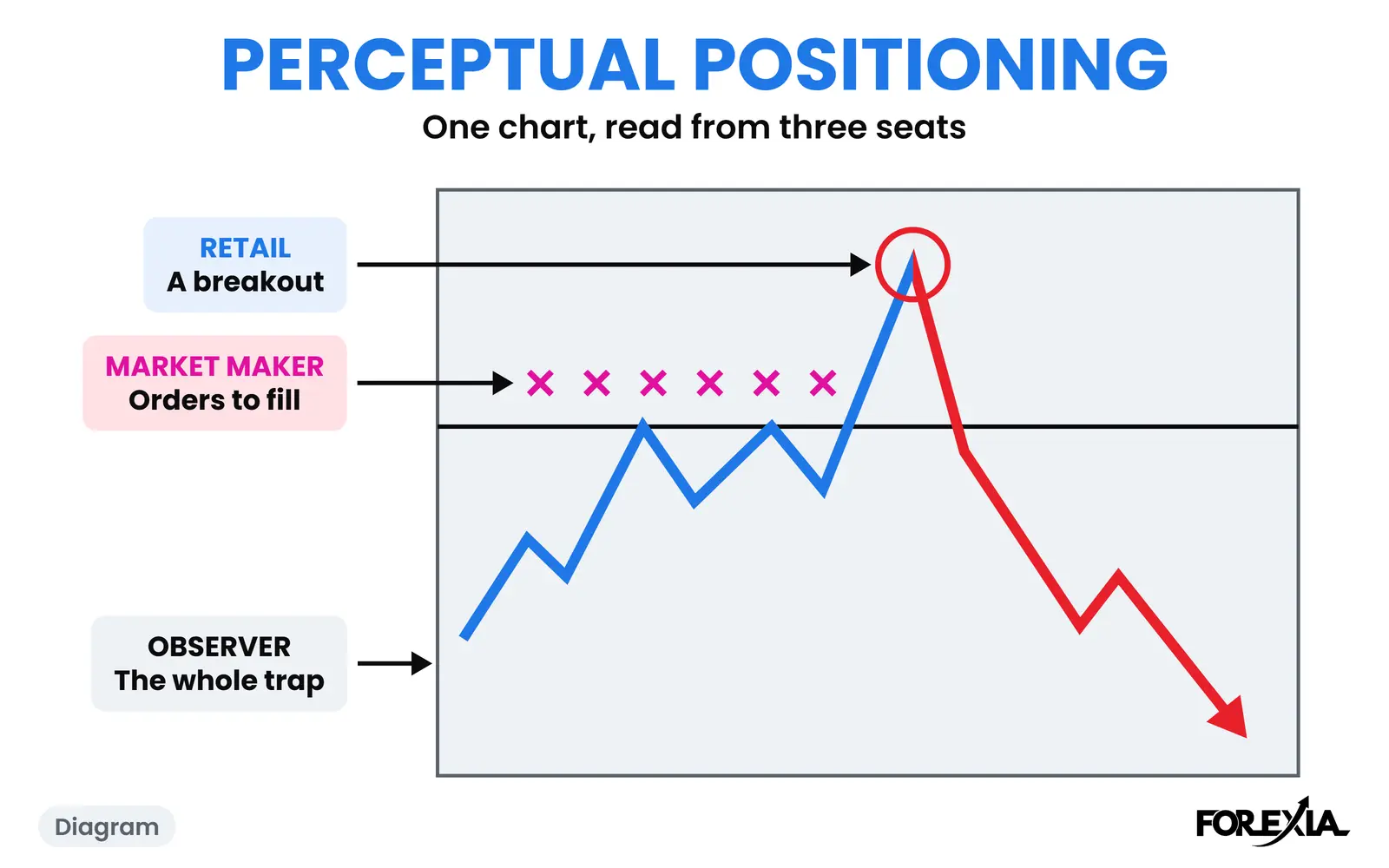
What does Perceptual Positioning look like on a chart?
It looks like one candle with three explanations. On gold on Wednesday 30 September 2026, the Asian Box ran from 4165.26 to 4194.85: 30 pips, where we count $1 as 1 pip. London pushed over the top, reached 4202.05 at 04:30 New York, 7 pips over, and fell back. A textbook calls that high resistance, says sell there, and puts the stop a few dollars above it.
At 08:30 New York, on US core PCE inflation and final GDP, one candle opened at 4192.82, ran to 4219.19 and closed at 4214.48. Its high was 17 pips over that resistance.
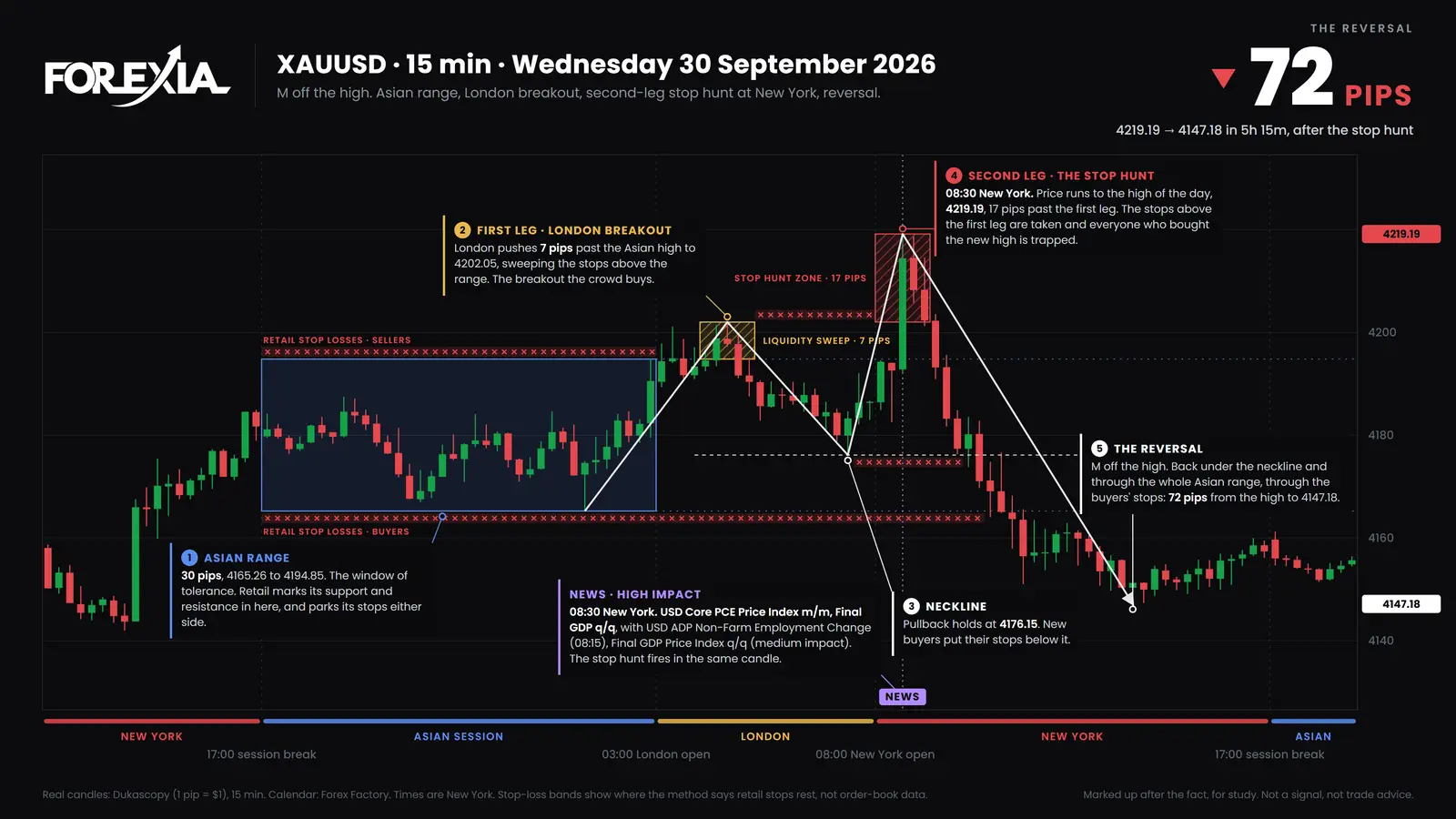
Now read that candle from the Three Seats.
- Retail. Resistance has failed. The seller is stopped out, and a new buyer chases the break.
- The market maker. Those stops are buy orders, and the chasers are buyers. Anyone who needs to sell in size needs exactly that. We read this candle as the fill.
- The observer. Holds both of those, and waits. The candle closed over the level, so it had proved nothing. The 09:15 candle was the first to close back under 4202.05, at 4193.23.
By 13:45 gold was at 4147.18, 72 pips off the high. The sellers at resistance had the direction right, and their stops were the first thing the market reached.
Two limits. Nobody outside can see those orders, so the middle seat is our reading of the structure, not order-book data. And a reversal seen afterwards is not a setup: our own test of this setup as a mechanical rule did not make money.
Perceptual Positioning and trading psychology: how do they relate?
Perceptual Positioning is one part of trading psychology, and it starts somewhere else. Most writing on the subject starts inside your head: fear, greed, discipline, the journal. Those are real, and what is trading psychology covers them. They describe you and leave out everyone else on the chart.
This starts with the others. What does each participant see, what does each need, and where does each have to act? The question after a loss changes with it. "I was not disciplined" becomes "I was standing where everyone stands."
The name is borrowed. Perceptual positions is an exercise from neuro-linguistic programming: step into another position and see the situation as they see it, then step outside both. We take the exercise and not the claims made for it. We found no study that tests it on traders, so treat it as a way of reading, not a proven edge. Nor does it rescue a rule that loses, which is the subject of why you can lose with a good strategy. What is perceptual positioning takes the idea further.
How do you spot which seat you are reading from?
Listen to the sentence you use about the chart.
"It's support, so I buy" comes from the first seat: a pattern and an order. "Stops rest under that line, and somebody large needs them" comes from the second. It names orders, and it is usually a guess. "I know what each side wants, and I am waiting to see which happened" comes from the third. It names no direction until a candle has closed.
Most of us think in the first seat by default, because that is what we were taught. It is still worth reading, since you can only find the crowd's stops by reading what the crowd was told. Liquidity Mapping puts that on the chart before the session.
What do traders get wrong about Perceptual Positioning?
Four mistakes come up most.
- Taking it as a mood. A calmer trader in the first seat is still in the first seat.
- Doing the opposite of every pattern. That is one more fixed instruction. On gold the textbook direction came. The book was predictable, not wrong.
- Treating the observer as a forecaster. The observer waits for the close and reads what happened. It says nothing about what comes next.
- Believing you can see the second seat. You infer it. Say so when you use it.
Which words does Perceptual Positioning lead into?
Five sit next to it.
- The Three Seats: retail, market maker, observer.
- Liquidity Visualization: using market structure to reverse engineer the retail mindset and see liquidity on the chart.
- Liquidity Mapping: marking the pools of stops before the session.
- Reverse Price Action: reading a pattern backwards, from where its stops sit to how the bigger players use that pool.
- The NPC: what trading education turns you into, a predictable bot who follows the trend.
Where is Perceptual Positioning taught?
Course 1 of ForexiaPRO, Reading the Map, starts this read in lesson 1.1.1, The Chart You Were Taught to Read, and names it in lesson 1.1.2, Retail, Market Maker, Observer.
Related words
- The Three Seats: Retail Trader vs Market Maker, and the Observer Who Reads Both
- Liquidity Visualization: Seeing Where the Crowd's Orders Rest Before a Sweep
- Liquidity Mapping: How to Mark the Pools of Stops Before the Session
- Reverse Price Action: Reading a Pattern Backwards, and What a Fake Breakout Really Is
- The NPC: What Trading Education Turns You Into, and One Reason Most Traders Lose
Frequently asked questions
What is Perceptual Positioning in trading?
It is seeing the same chart from three seats: the retail trader, the market maker, and the observer who sees the whole trap. Instead of asking only what you think of a candle, you ask what each of them sees in it and what each of them needs from it.
Is Perceptual Positioning a real psychology term?
The idea is borrowed. Perceptual positions is an exercise from neuro-linguistic programming: step into another person's position and see the situation as they see it, then step outside both. Applying it to a chart with these three seats is Forexia's. We use it as a way of reading, and we found no study that tests it on traders.
What is the difference between Perceptual Positioning and the Three Seats?
Perceptual Positioning is the act of changing where you read from. The Three Seats are the places you read from: retail, market maker and observer.
Will Perceptual Positioning make me a profitable trader?
Nothing here says so. It changes what you see on a chart, and it does not turn a losing rule into a winning one. Forexia's own test of its setup as a mechanical rule did not make money.