
The Close Back: How a Liquidity Sweep Is Confirmed, Candle by Candle
The Close Back is the spike that closes back inside the level it pushed through, and it is the proof a liquidity sweep has happened rather than a real break. It is the plainest liquidity sweep confirmation: the test is the candle's close, not its wick and not its size. It proves what has happened. It does not promise what comes next.
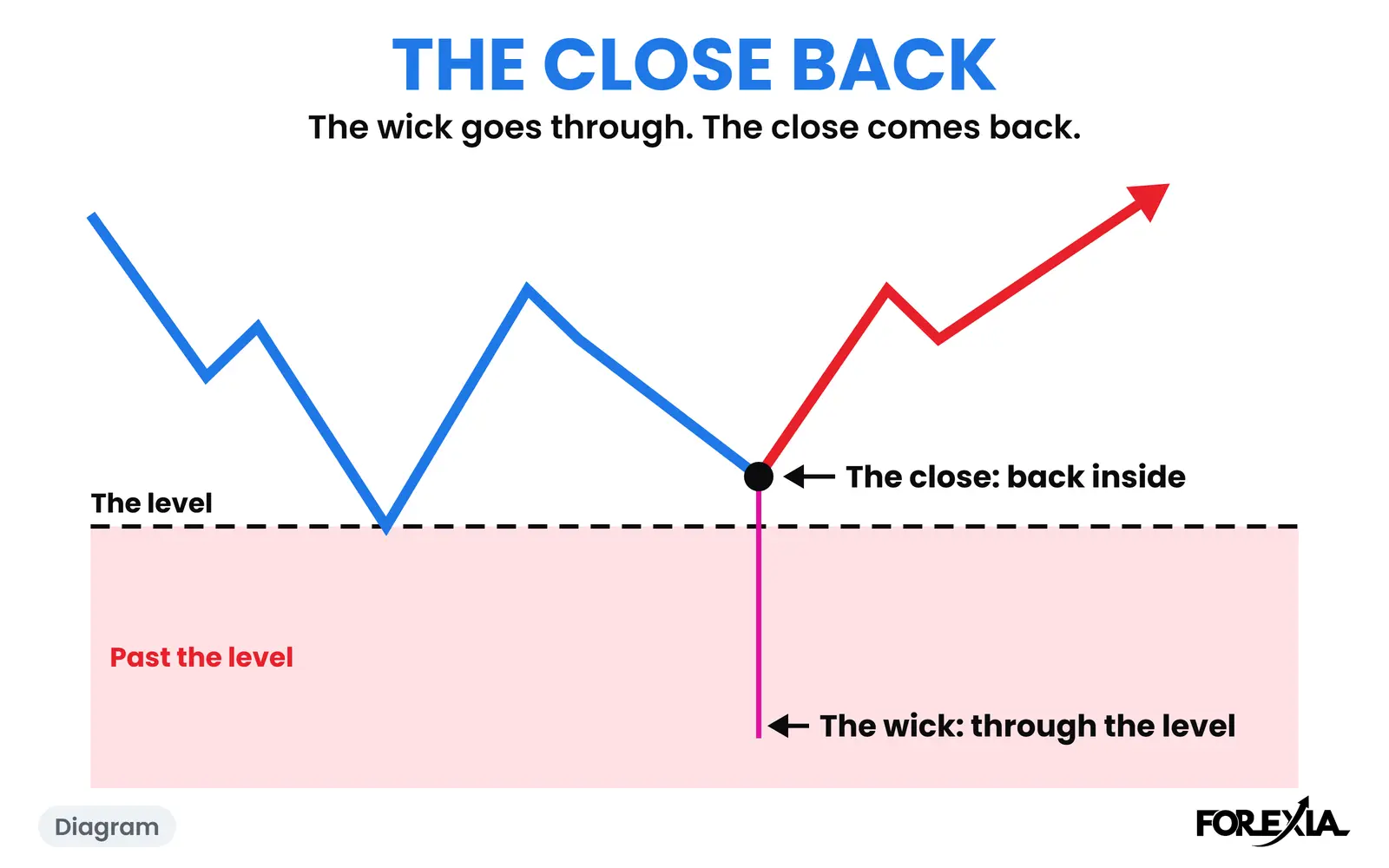
What does the Close Back look like on a chart?
It looks like any candle until it ends. On USD/CAD on Wednesday 12 August 2026 the level was Tuesday's low, 1.39147, 3 pips under the Asian Box (1.39180 to 1.39331). US inflation came out at 08:30 New York, and the candles after it show every version of the word.
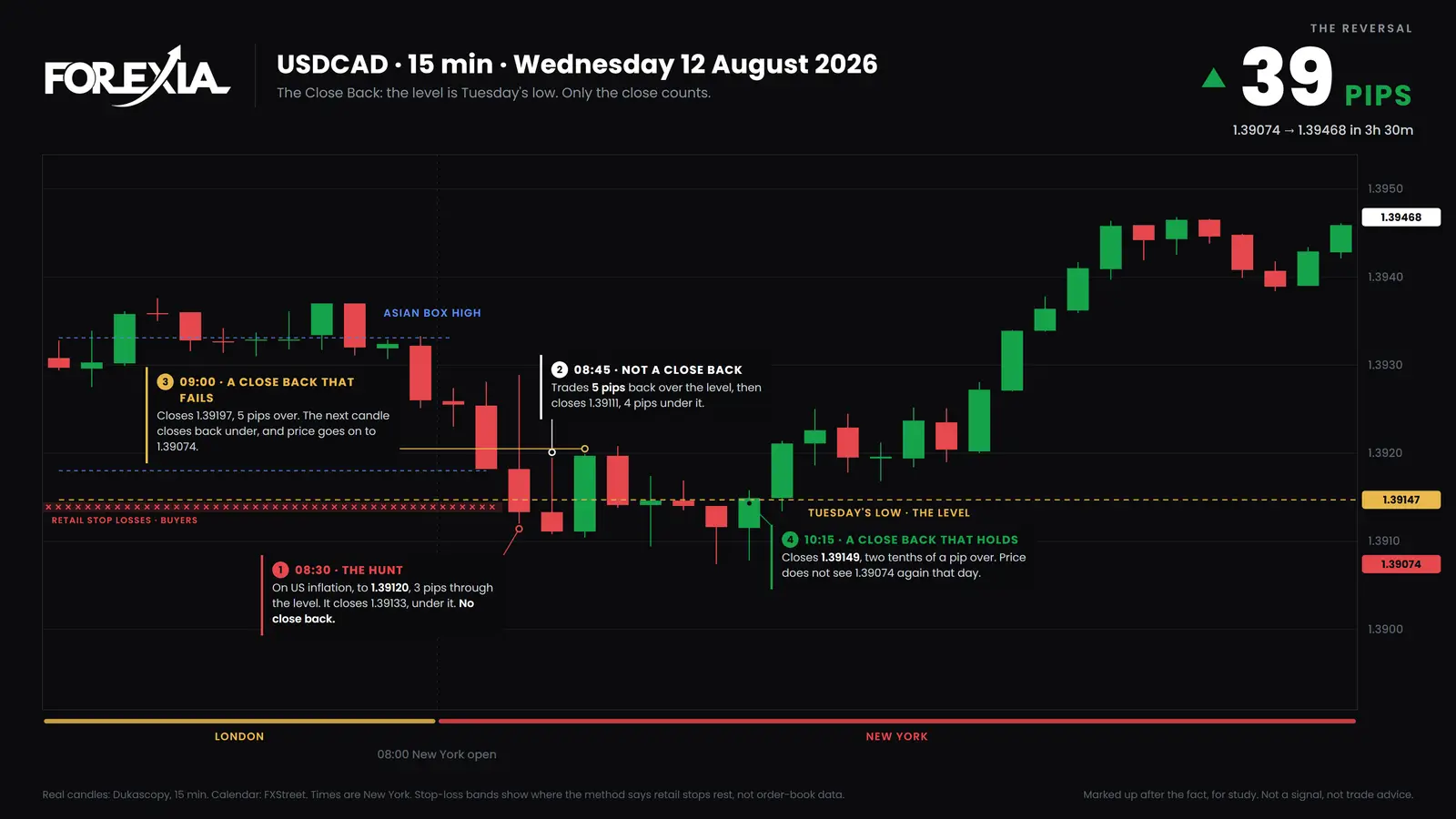
- 08:30, the Stop Hunt, the liquidity sweep. To 1.39120, 3 pips through the level. It closes at 1.39133, under it. No close back.
- 08:45, the wick. Trades to 1.39195, 5 pips back over the level, then closes at 1.39111, 4 pips under. It looked like a close back until the candle ended. It was not one.
- 09:00, a close back that fails. Closes at 1.39197, 5 pips over. The next candle closes under again, and by 10:00 price is at 1.39074, 3 pips past this candle's low of 1.39104.
- 10:15, a close back that holds. Closes at 1.39149, two tenths of a pip over. Price does not see 1.39074 again that day, and reaches 1.39468 by 13:30, 39 pips off the low.
Five pips over failed. Two tenths held. The size told you nothing.
The Three Seats read those candles differently. From the first seat, the spike is the move, and the crowd chases it. From the market maker's seat, it is the fill. Until the candle closes it can go further, so the observer waits for the close.
The Close Back and liquidity sweep confirmation: how do they differ?
The Close Back is our name for the first test a liquidity sweep has to pass. Guides offer a menu of confirmations: a close back inside the level, a shift in the swings on a smaller chart, a retest. The last two describe what came after. Only the close is about the sweep itself: price went past the level and could not stay there when the candle ended.
Two things separate our word from the searched phrase. "Confirmation" usually means a reason to enter. The Close Back confirms a fact about the past, and acting on it is a separate decision. And it is read on one chart, on our pages the 15-minute, because a 1-minute candle can close back while the 15-minute closes beyond. Liquidity grab vs breakout uses it to separate a sweep from a real move.
How often does a level that is taken close back?
About four times in five, the same day. We counted seven majors and gold on 15-minute candles from 6 April to 1 October 2026. A level is an edge of the Asian Box, or the previous day's high or low if Asia had not traded past it. Taken means through it after the London open, by at least 3% of the average daily range. We left out the wick of the first candle after the session break, which is often only the spread. Of 1,601 levels taken:
- 397 (25%) closed back on the same candle
- 595 (37%) closed back within the next hour
- 318 (20%) closed back later that day
- 291 (18%) had not closed back by the end of the day
Those 291 are the real breaks, and they ran further: a median of 65% of the average day past the level by the end of the day, against 9% for the levels that closed back.
A close back does not settle it. After 825 of the 1,310 close backs (63%), price traded past the wick again later the same day. The neat one-candle wick in the guides' diagrams was overrun most: 301 of 397 (76%), against 524 of 913 (57%) for those that took longer. A one-candle wick is usually shallower, so there is less to pass.
This counts candles, not trades: no entry, stop, cost or filter. Our own test of the setup as a mechanical rule did not make money.
How do you spot a close back?
Mark the level before the session, then ignore the wick. When price trades past the level, wait for that candle to end and ask which side the close landed on. The level is the one the spike pushed through, and the stop hunt forex guide shows where those sit. Over a high it is the same read in a mirror. A level can close back more than once in a day, and you only learn afterwards which one held.
What do traders get wrong about the Close Back?
Three mistakes show up on that one day.
- Reading a wick as a close. At 08:45 price was 5 pips back over the level, and it closed 4 under.
- Acting on the hunt. Buying the 08:30 spike meant sitting through 1.39074, 5 pips lower, an hour and a half later.
- Reading it as a forecast. The 09:00 close back was real. Price still went past its wick 30 minutes later.
Which words does the Close Back lead into?
Three sit next to it.
- The Stop Hunt: price driven into clustered stops to fill the other side.
- Reverse Price Action: reading a pattern backwards, from where its stops sit to how the bigger players use that pool.
- The Reversal Candle: one huge candle through the stops, straight after the crowd gets in.
Where is the Close Back taught?
Course 3 of ForexiaPRO, Reverse Price Action, teaches this read step by step in lesson 3.3.1.
Related words
Frequently asked questions
How do you confirm a liquidity sweep?
Wait for the candle to close. If a candle that traded through the level closes back on the side it came from, the sweep has happened. Forexia calls that the Close Back. A wick back inside that still closes outside is not one. Choose your chart first, because a 1-minute candle can close back while the 15-minute candle closes beyond.
What is the difference between a liquidity sweep and a breakout?
The first candle can look the same. A breakout keeps closing beyond the level. A sweep closes back inside it. In our count of 1,601 levels taken on seven majors and gold from 6 April to 1 October 2026, 291 had not closed back by the end of the day.
Does a close back mean price will reverse?
No. It proves the sweep has happened, not what comes next. In the same count, after 825 of 1,310 close backs (63%), price traded past the wick again later that day. That is a count of candles, not of trades, and Forexia's own test of the setup as a mechanical rule did not make money.
How many candles can a close back take?
There is no fixed number. In our count, 25% of the levels taken closed back on the same candle, 37% within the next hour and 20% later that day. The other 18% had not closed back by the end of the day.