Stop Hunt vs Liquidity Sweep: Are They the Same Thing?
Dylan Forexia8 min read
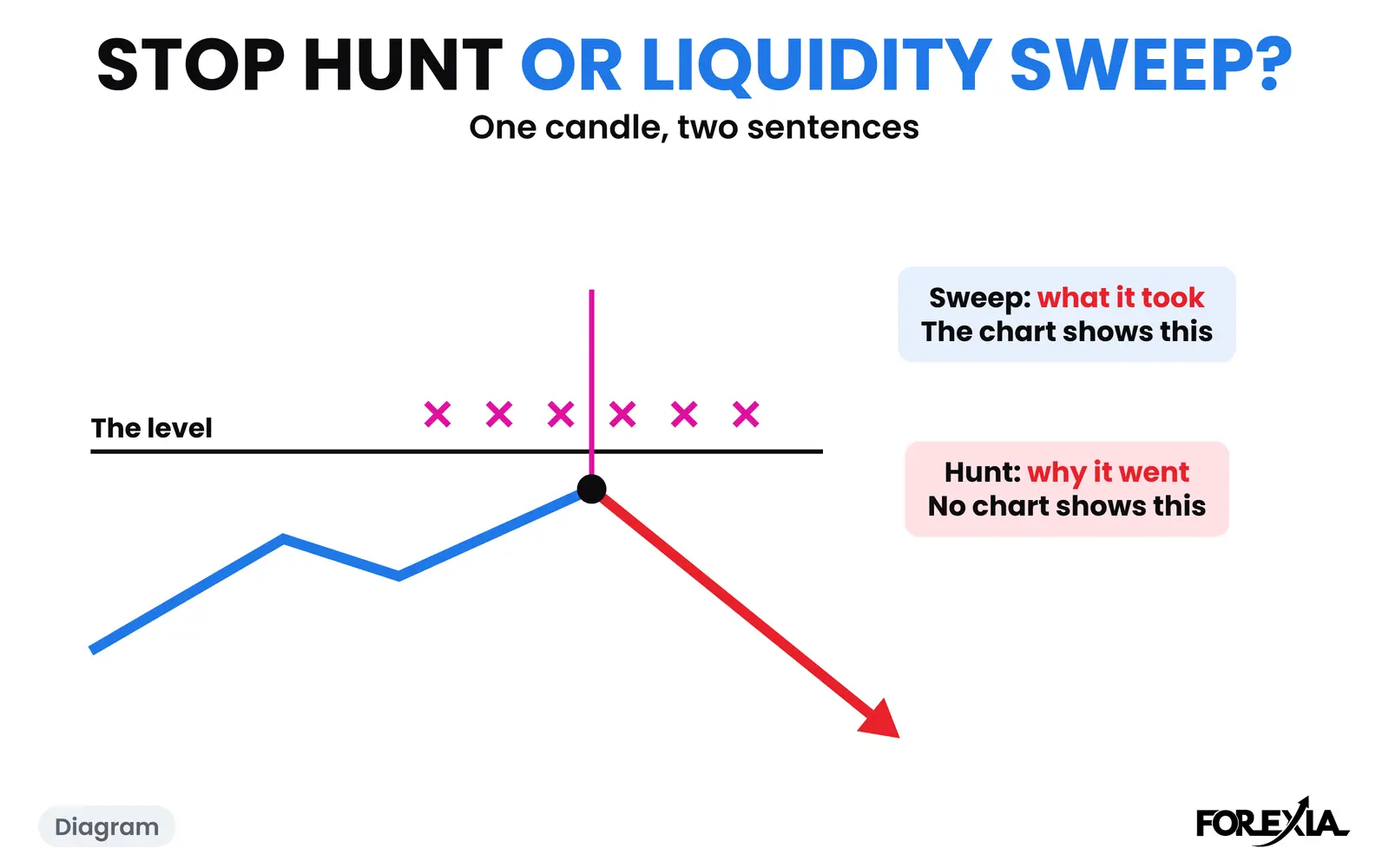
Stop hunt vs liquidity sweep is one candle and two claims. A liquidity sweep says price went past a level, took the orders resting there and closed back. A stop hunt says it went there for those orders. The first you can read from a chart. The second no chart can show.
Most pages call them synonyms and move on, and in everyday use they are. We use The Stop Hunt ourselves, for the same move other people call a sweep. But the swap hides a question that matters when your stop is the one that went: did someone do this, or did it just happen? Here is the test, on two real days. For the wider picture, start with stop hunting in forex.
Stop hunt vs liquidity sweep: what each word claims
They describe the same price action and differ in how much they assert about it.
| Liquidity sweep | Stop hunt | |
|---|---|---|
| What it names | What the move took: the orders past a level | Why the move went: to get those orders |
| What it claims | Price went past the level and a candle closed back | All of that, and a purpose behind it |
| What a chart can show | The trip and The Close Back. Not the orders themselves | The same candles, and nothing about purpose |
| What would prove it | A second feed, for the price. An order book, for the orders | Records of who did what and why, which only a regulator can demand |
| Can it happen with nobody behind it? | Yes | Not by its own meaning |
| Where you meet it | Trading guides and indicators | Forums, and in slightly different words, regulators |
| How we use it | Beside our word, as the term most people search | Our word, always as a read |
So the honest answer has two parts. On the chart they are the same thing, and every test that separates a sweep from a real break separates a hunt from one too. In meaning they are not the same, because one has a motive in it.
Where the words really split: the FX Global Code
The clearest line we know of is in the industry's own code of conduct, and it turns on one thing: intent. The FX Global Code, the voluntary standard written with central banks for the wholesale market (updated December 2024), covers clients' stop-loss orders in its Principle 10.
It says a dealer should tell clients whether its risk management trades "may be executed close to a Stop Loss Order trigger level", and that they "may impact the reference price and result in the Stop Loss Order being triggered". That is allowed, with disclosure.
Then it lists as an unacceptable practice "trading or otherwise acting in a manner designed to move the market to the Stop Loss level".
Read those side by side. In both cases a dealer trades near a stop and the stop fires. The candle could be identical. All that separates them is what the trade was designed to do, and that is the same line as the one between our two words. A chart cannot draw it. The academics use a third word with no motive in it at all: a New York Fed staff report calls stops firing one after another a "price cascade". Whether anyone has been shown going after stops is on is forex rigged, with the regulators' own wording.
A sweep with an obvious cause: EUR/USD, 7 August 2026
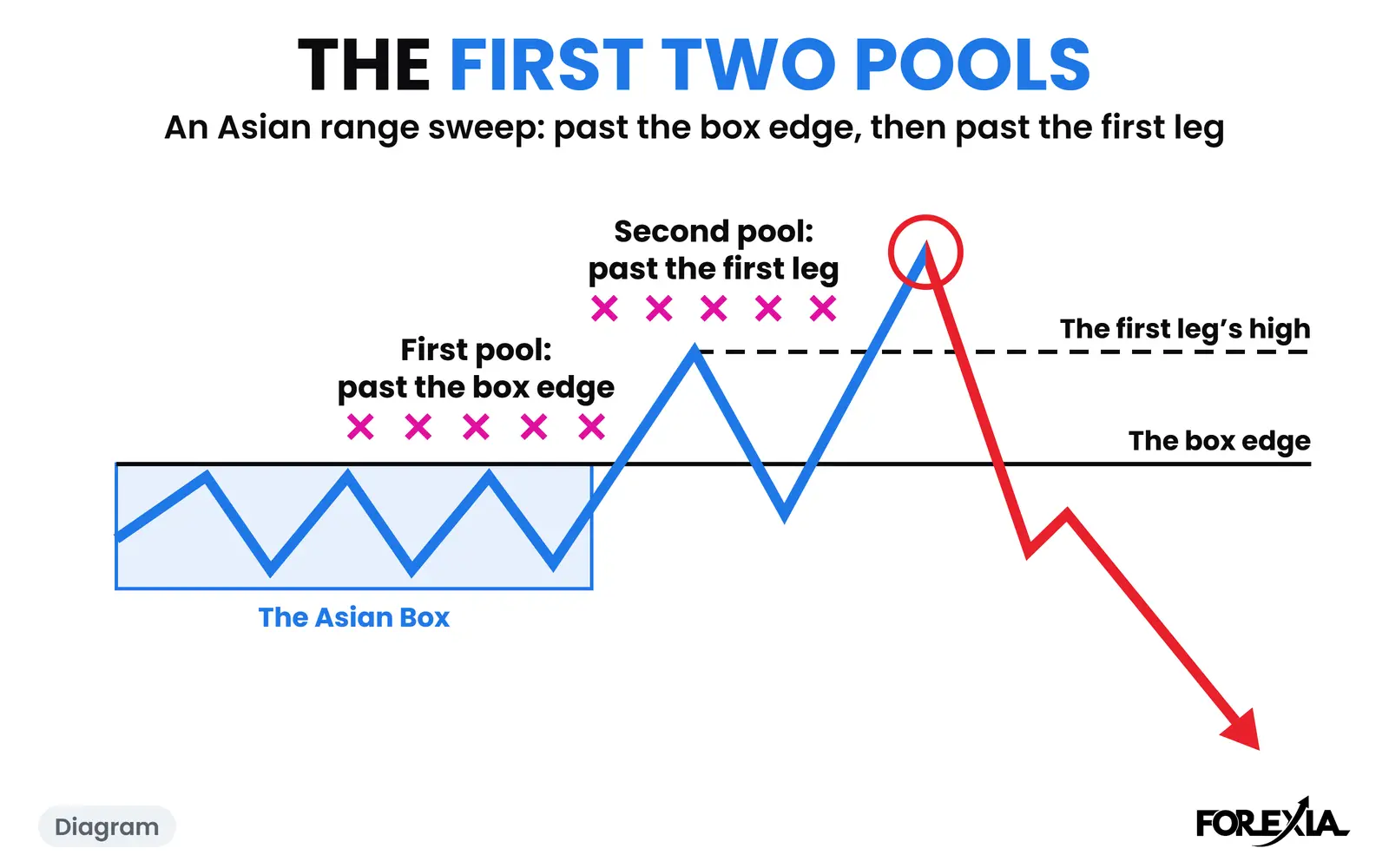
Start with the case where the neutral word fits best. On Friday 7 August 2026, Nonfarm Payrolls came out at 08:30 New York. Thursday's high on EUR/USD was 1.15594. The 08:30 candle went from 1.15276 to 1.15771, 18 pips over that high, and closed 14 pips over it at 1.15734. The 08:45 candle reached 1.15808, the high of the day, 21 pips over. The 09:45 candle closed back under it at 1.15576, and the last candle of the day closed at 1.15558.
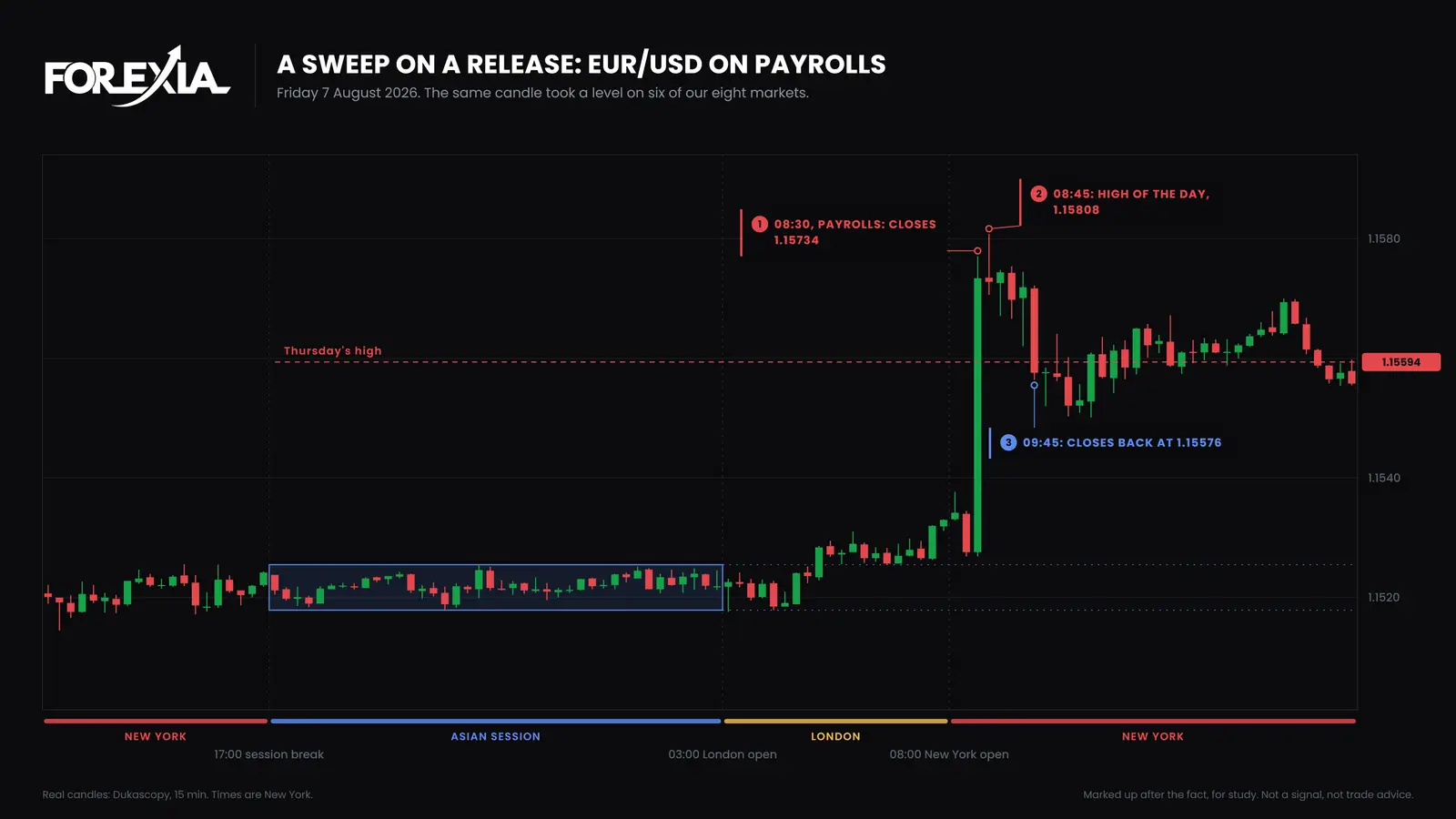
That is a liquidity sweep by any test. Is it a hunt? The same 08:30 candle took a level on six of our eight markets: EUR/USD, GBP/USD, USD/JPY, AUD/USD, USD/CAD and NZD/USD. By that we mean it was the first candle that day to trade past an edge of the Asian range, or the previous day's high or low, by at least 3% of the average daily range. They did not behave alike afterwards. EUR/USD and AUD/USD closed back on the 09:45 candle and NZD/USD on the 09:15. USD/JPY took two levels, closed back over one on the 09:45 candle and not over the other that day. GBP/USD and USD/CAD did not close back that day. A jobs number that moved the dollar everywhere needs no one aiming at any one market's stops.
Our read does not stop there. We read a scheduled release as the moment price is most likely to go for a pool, because everyone knows the minute and orders gather around it, and we call that News-Induced Liquidity. The candle cannot separate the two. The number moved the market, and the stops were there to be taken, and both of those can be true.
A sweep with no cause on the calendar: USD/CAD, 30 June 2026
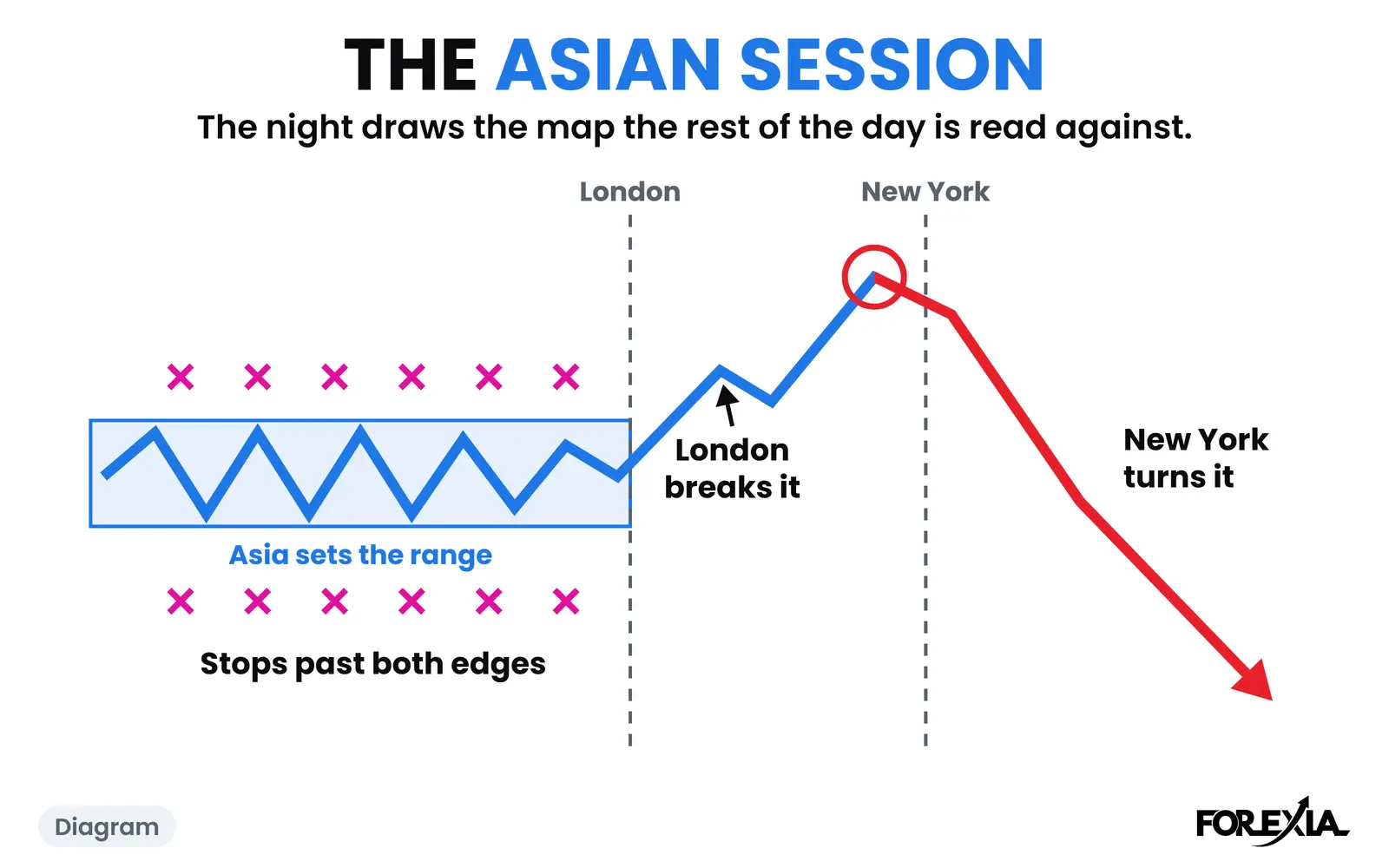
Now the case where the loaded word is most tempting. On Tuesday 30 June 2026, USD/CAD left a 41-pip Asian range, 1.41986 to 1.42392, wide for this pair. The 07:30 New York candle opened at 1.42384, ran 8 pips over the top to 1.42473 and closed at 1.42391, a tenth of a pip back inside. The next medium-impact release for either currency was at 08:15. It turned out to be the high of the week, and by 16:00 price was at 1.41778, 70 pips lower and through the whole range.
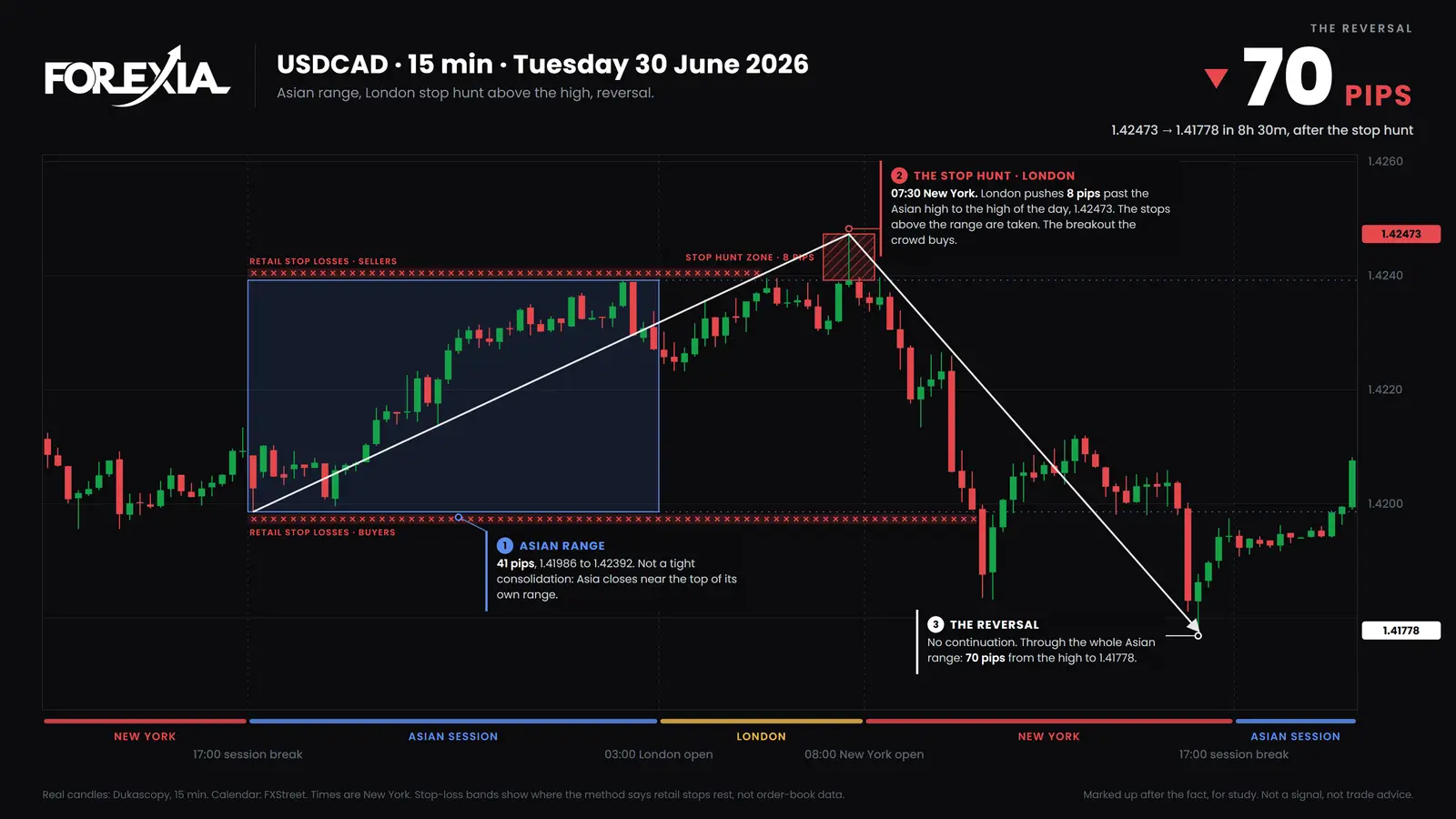
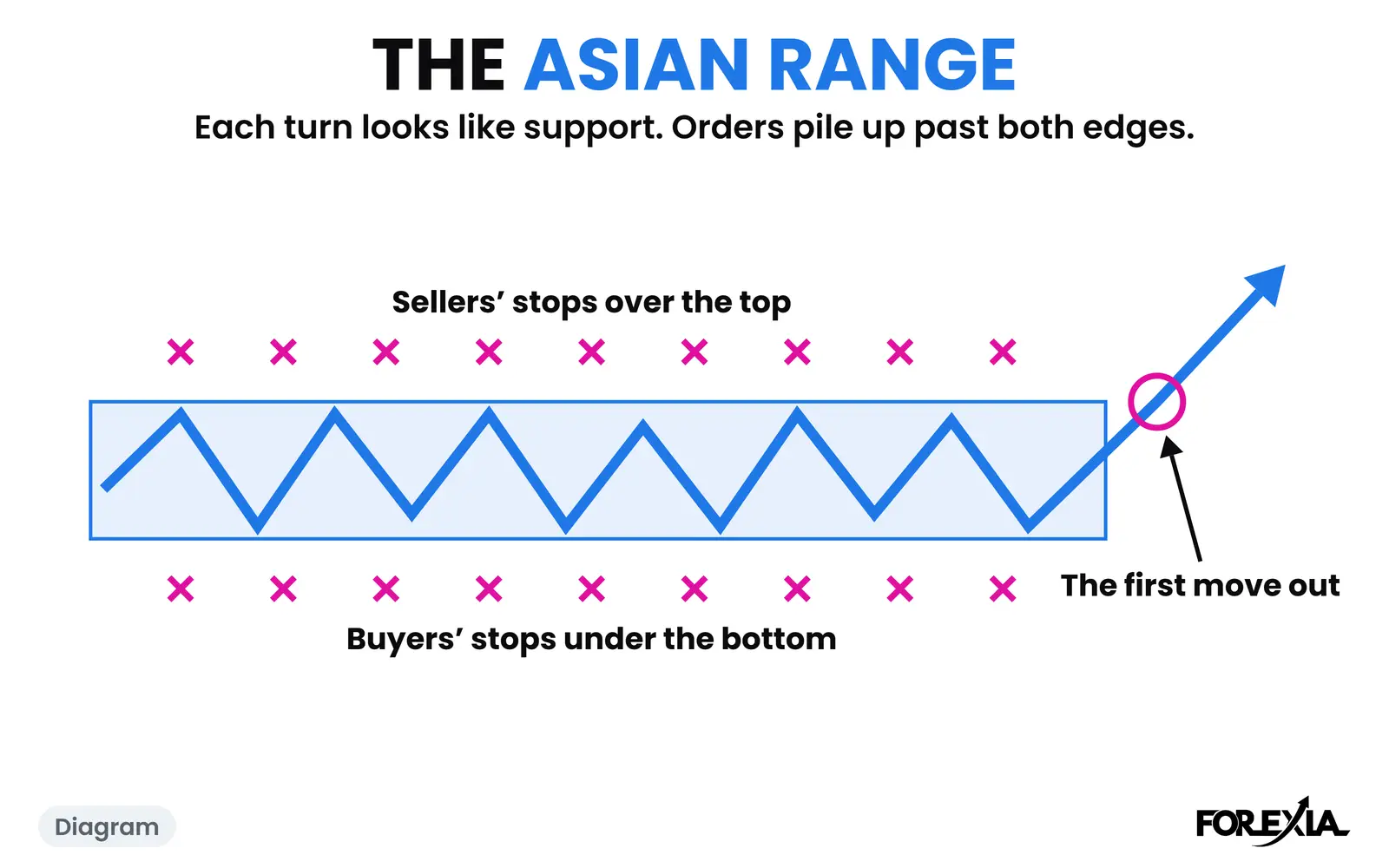
There is a visible level, a short trip past it and no news. That is what most people picture when they say hunted, and it is how we read it: sellers' stops over the range, breakout buyers on top of them, and a turn once those orders were spent.
Look closer, though. The same 07:30 candle also took the Asian low on GBP/USD and closed back on the same candle. So this was a dollar push on at least two markets, not one pair's stops being singled out. A tenth of a pip is also a thin margin to call anything: on a feed a pip away, that candle may not have closed back at all. And a large order with nothing to do with the level would print the same thing.
So the day with no news does not prove a hunt, and the day with news does not rule one out. That is the whole result of the test.
When does the choice of word matter?
It matters when you review your own loss, and it can change what you do next.
- "I was hunted" ends the review. It explains the loss by someone else's act, and no chart can check it. Your read and your size never come under question.
- "My stop was swept" keeps it open. It says your stop was in the pool. You can then ask whether it closed back, what was on the clock, and whether your stop loss keeps getting hit for a reason of your own.
- "It was hunted" is fine as a read. Reading from the three seats, the market maker's seat is useful because it asks where the orders were. Just keep the "we read this as" attached. It explains why price hits a stop and then reverses without claiming to know who did it.
If you are comparing a hunt with a real break, a close back is the test, and that one works whichever word you use. The other names people give it are covered in stop hunt vs fakeout, and those who split the words by speed are answered in sweep, grab or run.
What this does not tell you
We picked these two days to test the words, after the fact, and two days are examples and not a sample. We have no count of how many sweeps come with a public cause or how many stand alone.
Neither word makes the next trade pay, either. Traded against each flagged hunt on seven dollar majors and gold, our own fixed rule lost money after costs in every year from 2021 to 2026, between -0.10R and -0.23R a trade, where R is the amount risked on one trade. That is one rule on one data source, and it says nothing either way about who moved a candle.
Course 3 of ForexiaPRO, Reverse Price Action, teaches this read step by step from lesson 3.2.1, The Stop Hunt.
Frequently asked questions
Are a stop hunt and a liquidity sweep the same thing?
They name the same candle and make different claims about it. A liquidity sweep says price went past a level, took the orders resting there and closed back. A stop hunt adds that price went there for those orders. The first can be read from a chart, apart from the orders themselves. The second cannot be read from any chart.
Why does Forexia say stop hunt if a chart cannot prove it?
Because it is the read we teach: market makers build the chart, and the stops are worth going to. We say so as a read, and we write 'we read this as' when we use it. The word is a way of looking at the move from that seat, and not a finding about who made any one candle.
Can a liquidity sweep happen with nobody hunting?
Yes. A release can do it, as Nonfarm Payrolls did across six of our eight markets on 7 August 2026. So can a large order with nothing to do with the level, a dealer hedging near a client's stop, or a chain of stops feeding itself. Those candles look the same as a deliberate one.
Is a stop hunt illegal if a sweep is not?
A chart alone cannot say, and this is not legal advice. The difference is what someone intended and did. The FX Global Code lists trading designed to move the market to a stop level as unacceptable, while allowing that a dealer's disclosed hedging may set a stop off. A candle shows neither.