
The Induction Trend: Why I Lose Money Trading the Trend the Week Starts With
The Induction Trend is the trend of Sunday, Monday and Tuesday that dumb money follows, and we read it as there to bring the crowd in before the week turns. If you are asking why I lose money trading the trend, this is one answer: you joined when it felt safest. It is one cause among several, and this page says where it stops.
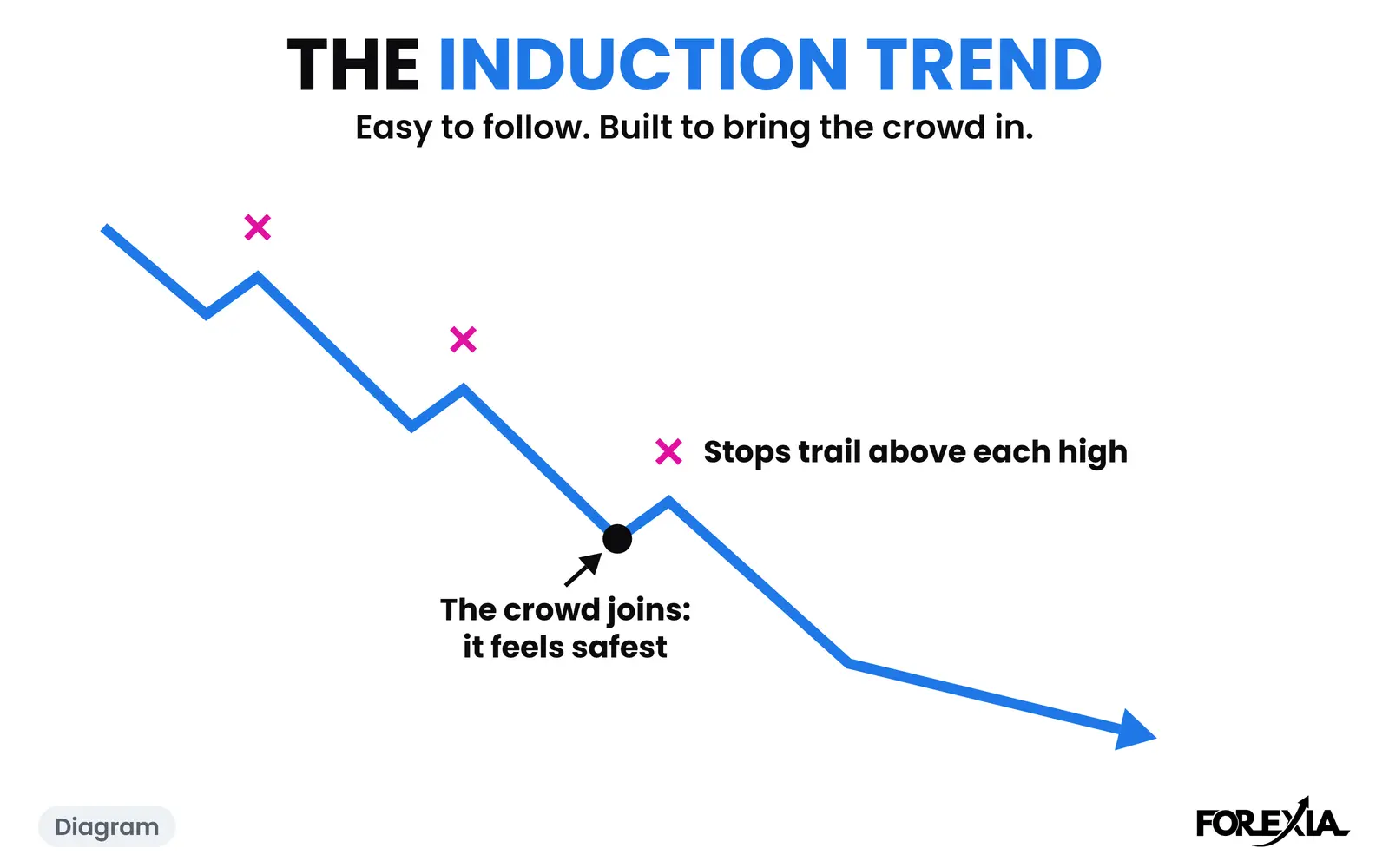
What does the Induction Trend look like on a chart?
It looks like the easiest trade of the week. EUR/USD opened the week of 22 June 2026 at 1.14603. Monday closed at 1.14270 and Tuesday at 1.13812, 79 pips under the open, with Monday's low at 1.14189 and Tuesday's lower at 1.13755. Two down days, each adding to the same side. We read the sellers as comfortable, with their stops trailing above each high.
At 09:00 New York on Wednesday price reached 1.13245, the low of the week, 51 pips under Tuesday's low. By 08:45 on Friday it was at 1.14338, 109 pips off that low.
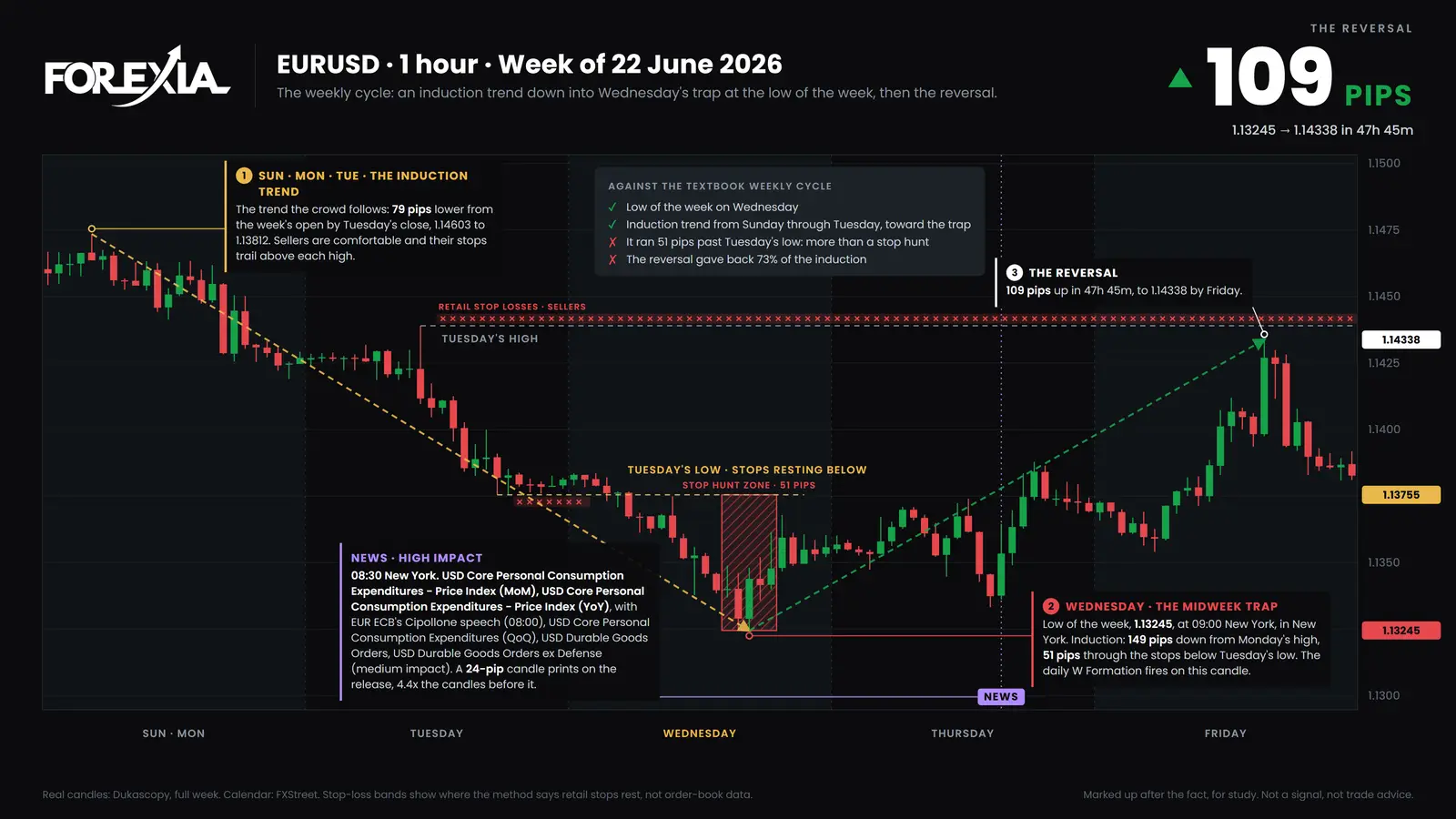
Sit in the seat of someone who sold Tuesday's close at 1.13812. On Wednesday morning that position was 57 pips ahead. On Friday morning it was 53 pips behind. The week closed at 1.13827, within 2 pips of where they got in. Nothing about Monday or Tuesday warned them, because the trend was real on both days.
This week did not finish the job, and that matters too. The rise gave back 109 of the 149 pips the week had fallen from Monday's high, and it stopped 5 pips short of Tuesday's high, 1.14390. The stops we read above that level were not reached. The week marked up in full has the rest.
The Induction Trend and why I lose money trading: how do they connect?
Pages on why traders lose money list the same causes: too much leverage, too much risk on a trade, costs, no plan. Those are real, and they are bigger than this word. In 2018 European regulators found that 74 to 89% of retail accounts typically lose money on CFDs. That figure is about CFD accounts as a whole. It is not a measure of the Induction Trend, and no reading of the week fixes an account that risks too much.
What the word adds is timing. "Follow the trend" says nothing about when. By Tuesday the trend is easy to see, and joining feels like the sensible thing. The Three Seats split there. Retail sees confirmation. The market maker, on our reading, sees orders arriving where they are wanted. The observer sees days closing one way, and asks who has just joined and where their stops sit.
If your method holds up and you still lose, why I lose with a good strategy takes that question further, and the weekly cycle forex guide puts this part in its place in the week.
How do you spot the Induction Trend?
On the week above, the days closed the same way and kept adding to one extreme, measured from the week's open. A week can just as easily go nowhere: USD/JPY in the week of 31 August 2026 was only 20 pips from its open by Tuesday's close, a range and not a trend.
It can be shorter or longer than the name suggests. On the Weekly Script page USD/CHF runs for three days and turns on Thursday. Some observers also check how much of the day's range Tuesday has used, which has its own word, ADR Met Tuesday.
You can only name it for certain afterwards. A trend that keeps going until Friday was just a trend. No public book shows retail positions, so "the crowd" here is a reading of where trend followers would be, not a measured figure.
What do traders get wrong about the Induction Trend?
Three readings cost the most.
- Taking comfort as evidence. Being ahead on Monday and Tuesday is what the word describes. It says nothing about Wednesday.
- Reading it as the week's move. On that EUR/USD week the trend was 79 pips by Tuesday, and the week closed 78 pips under its open. The direction held. The seller at Tuesday's close still made nothing.
- Fading every early trend. Selling or buying against every Tuesday is not a plan. Some weeks never turn. A reversal seen afterwards is not a setup, and our own test of the daily setup as a mechanical rule did not make money.
Which words does the Induction Trend lead into?
Three sit next to it.
- Dumb Money: the predictable retail herd the chart is built to trap.
- ADR Met Tuesday: the average daily range used up by Tuesday.
- The NPC: what trading education turns you into, a predictable bot who follows the trend and asks no questions.
Where is the Induction Trend taught?
The Induction Trend is taught in Course 4 of ForexiaPRO, The Week, in production.
Related words
Frequently asked questions
What is the Induction Trend?
It is the trend of Sunday, Monday and Tuesday that dumb money follows. We read it as there to bring the crowd in before the week turns. The purpose is our reading: what can be shown is days closing one way, then a turn that runs through the levels those days left behind.
Why do I lose money trading the trend?
Often for reasons with no connection to the week: too much leverage, too much risk on a trade, costs, no plan. The Induction Trend adds one about timing. By Tuesday the trend is easy to see, and that is when joining it feels safest. On EUR/USD in the week of 22 June 2026, a seller at Tuesday's close was 57 pips ahead on Wednesday and 53 pips behind on Friday.
Is every trend from Monday to Tuesday an induction?
No. A trend that keeps going until Friday was simply a trend, and you only know which it was afterwards. The word names a part of a week that turned. It does not tell you this week will turn.
Does the Induction Trend always last until Tuesday?
No. It can stop after one day or run on through Wednesday. On USD/CHF in the week of 28 September 2026 it ran for three days, and the turn came on Thursday. Sunday's hours count as part of Monday.