
The #SignatureTrade: The Wedge, the Window and the Confirmations
Signature trade forex is Forexia's name for a setup that runs over two days, the #SignatureTrade. Day one shows a wedge. Day two shows a clear Asian range. The window opens when price breaks the wedge and the previous day's high or low, usually at the London open. Many traders know the first part as a rising wedge pattern; the #SignatureTrade adds two conditions around it.
What is the #SignatureTrade?
Three things, in order. A wedge forms on day one, where price narrows between two converging lines. The Asian range on day two is easy to see. Then price goes through the wedge and through the previous day's high (the sell version) or low (the buy version), which is where the stop hunt shows itself. We read that break as the point where the crowd believes the trend will continue.
If the wedge is not clear, or the range is not obvious, it is not a #SignatureTrade, and we never force the shape. The definition, with one real USD/CAD day, is in the glossary: what the #SignatureTrade is.
Day one the wedge, day two the Asian range
The wedge is judged by eye, mostly on the 15-minute and 1-hour charts. A rising or falling wedge counts, and so does a triangle or anything of that family. The Asian range on day two is the Asian Box: the more consolidated, the better.
The break and the window
The break usually comes in the hour and a half either side of the London open or the New York open. The Window of Opportunity is the name for the break of the previous day's extreme.
The evidence: every trade the bot sent
Below, the three moves of the course are drawn beside one real trade, followed by every Signature Trade the free channel has sent. The record starts on 4 October 2026, the day the live scanner began sending. Each signal is copied into the record when it is sent, with a fingerprint of its fixed fields, and its outcome follows. Losses are listed like wins. The record gives counts and levels, not a win rate or a profit figure, because the sample is too small to carry one.
On 11 November 2026 the record held nine signals, four of them Signature Trades, and all four had closed: one reached all four targets, one closed at the time limit after the third target, one was closed after the first target when price came back, and one was stopped before reaching any target. The trade log is always the current count.
Read the whole record in the trade log, or open the case files one signal at a time.
What the bot does and does not do. The live bot automates the induction and the reversal. It does not read the wedge itself: its test for the first move is that yesterday consolidated (an inside day or a small range). So these trades are the Signature Trade in its mechanical form, not the full course setup with a drawn wedge. The textbook sketch is a drawing and is labelled one.
What our test says
We tested the setup as a mechanical rule, with fixed conditions, and it did not make money. That is why we call the #SignatureTrade a description of where to look and who is on each side of the chart, and not a rule that works.
Where to go next
- Rising wedge breakout: the #SignatureTrade explained
- Previous day high breakout at the London open
- Confluence trading in forex
- Why trading setups fail
The words
- Confirmation Stacking: How Many Confirmations Does a Forex Setup Need?
Confirmation Stacking is adding reasons until a setup feels certain. Two real days and 332 scored setups show what a stack tells you, and what it does not.
- Pending Limit Orders: What Resting Orders Before London Face
Pending limit orders are orders placed hours before London, in the liquidity zones. What they faced on GBP/USD, 22 May 2026, and what the count says.
- Textbook or Partial: How We Grade a Forex Setup Day
Textbook or Partial is how cleanly a day played the setup. Two EUR/USD days on one chart, 9 and 10 June 2026, 50 pips against 39, and 332 days counted.
- The #SignatureTrade: a Wedge, a Clear Asian Range and the Break Everyone Believes
The #SignatureTrade is a wedge on day one, a clear Asian range on day two, and a break of the wedge and the previous high. A real USDCAD day.
- The Window of Opportunity: When the Signature Trade's Entries Cluster Around the London and New York Open
The Window of Opportunity is the hour and a half either side of the London or New York open. EUR/USD on 12 August 2026, and 422 previous-day levels counted
Textbook next to the real thing
The same moves, on a drawing and on a real signal. The numbers on the left match the numbers on the right.
The #SignatureTrade, as the course teaches it
- 1Problem: a wedge. A rising correction inside a downtrend. Dumb money reads it as a pause, sells the break, and puts its stops just above.
- 2Reaction: the induction. Price breaks out past the high in a volatile stop hunt into the liquidity zone, and the crowd piles in.
- 3Solution: the reversal. With the stops taken and the crowd trapped, price turns and runs the other way.
Sell version drawn; a buy is the mirror image, off a low.
USD/CHF sell, 14 October 2026
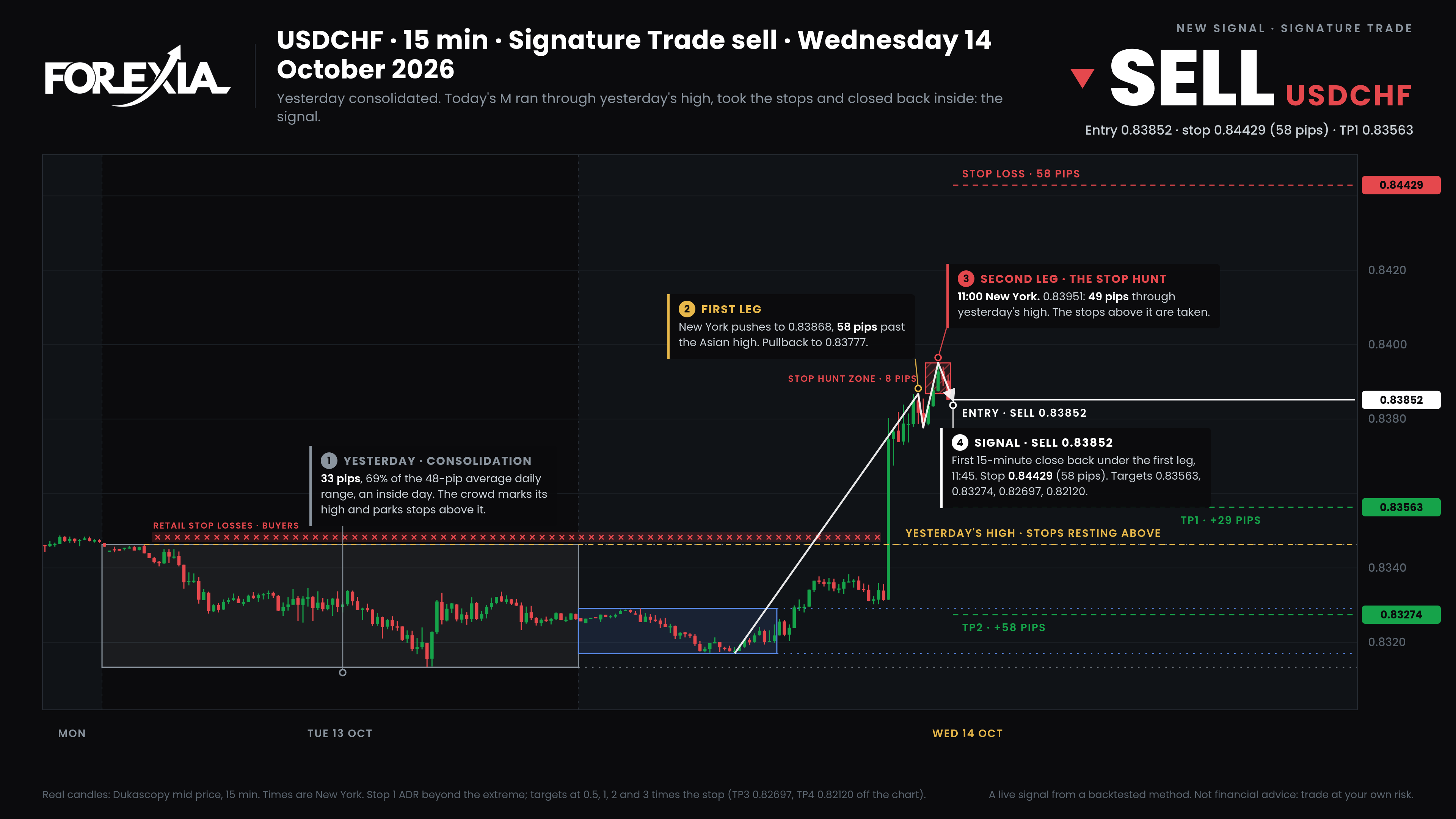
- 1Problem: yesterday consolidated, the bot's stand-in for the wedge, leaving the crowd's stops beyond its high at 0.83463
- 2Reaction: the induction: price pushes to 0.83868, pulls back to 0.83777, then a second leg 8 pips past it takes the stops (49 pips through yesterday's high)
- 3Solution: the first close back inside gives the signal at 0.83852; stop 0.84429, first target 0.83563
All 4 targetsopen the case file
What the bot does and does not do. The live bot automates the induction and the reversal. It does not read the wedge itself: its test for the first move is that yesterday consolidated (an inside day or a small range). So these trades are the Signature Trade in its mechanical form, not the full course setup with a drawn wedge.
Every Signature Trade we sent, wins and losses
4 Signature Trades sent to the free channel (4 closed, 0 open): 1 hit all four targets, 1 closed at the time limit with targets hit, 1 hit at least one target and closed, 1 were stopped with no target. Too few to say whether the method works; they are here because the record is the point.
- Flagged
- 14 Oct 2026, 15:45 UTC
- Entry
- 0.83852
- Stop
- 0.84429 (58 pips)
- TP1 / TP4
- 0.83563 / 0.82120
- Group
- Free channel
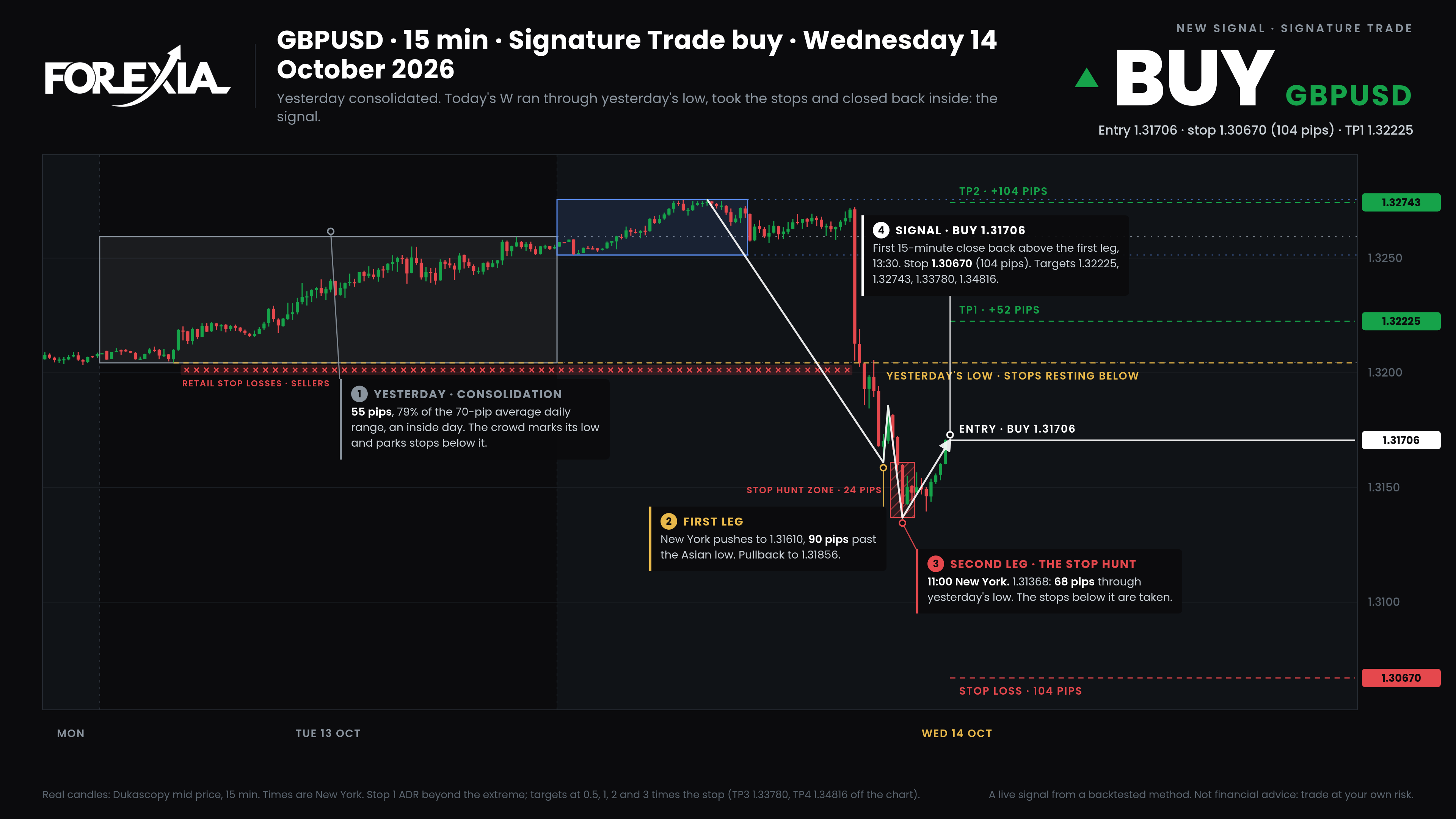
- Flagged
- 14 Oct 2026, 17:30 UTC
- Entry
- 1.31706
- Stop
- 1.30670 (104 pips)
- TP1 / TP4
- 1.32225 / 1.34816
- Group
- Free channel
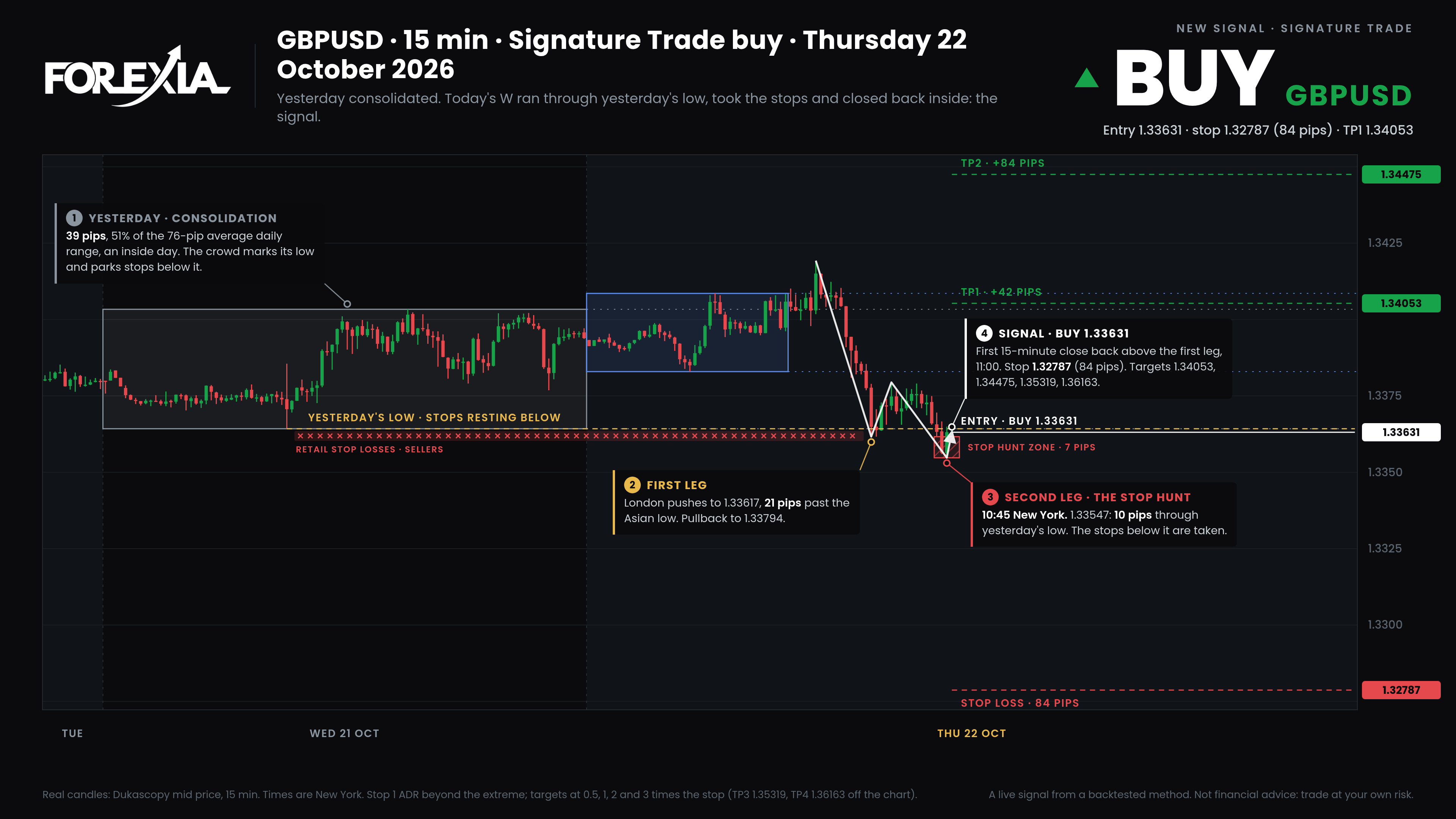
- Flagged
- 22 Oct 2026, 15:00 UTC
- Entry
- 1.33631
- Stop
- 1.32787 (84 pips)
- TP1 / TP4
- 1.34053 / 1.36163
- Group
- Free channel
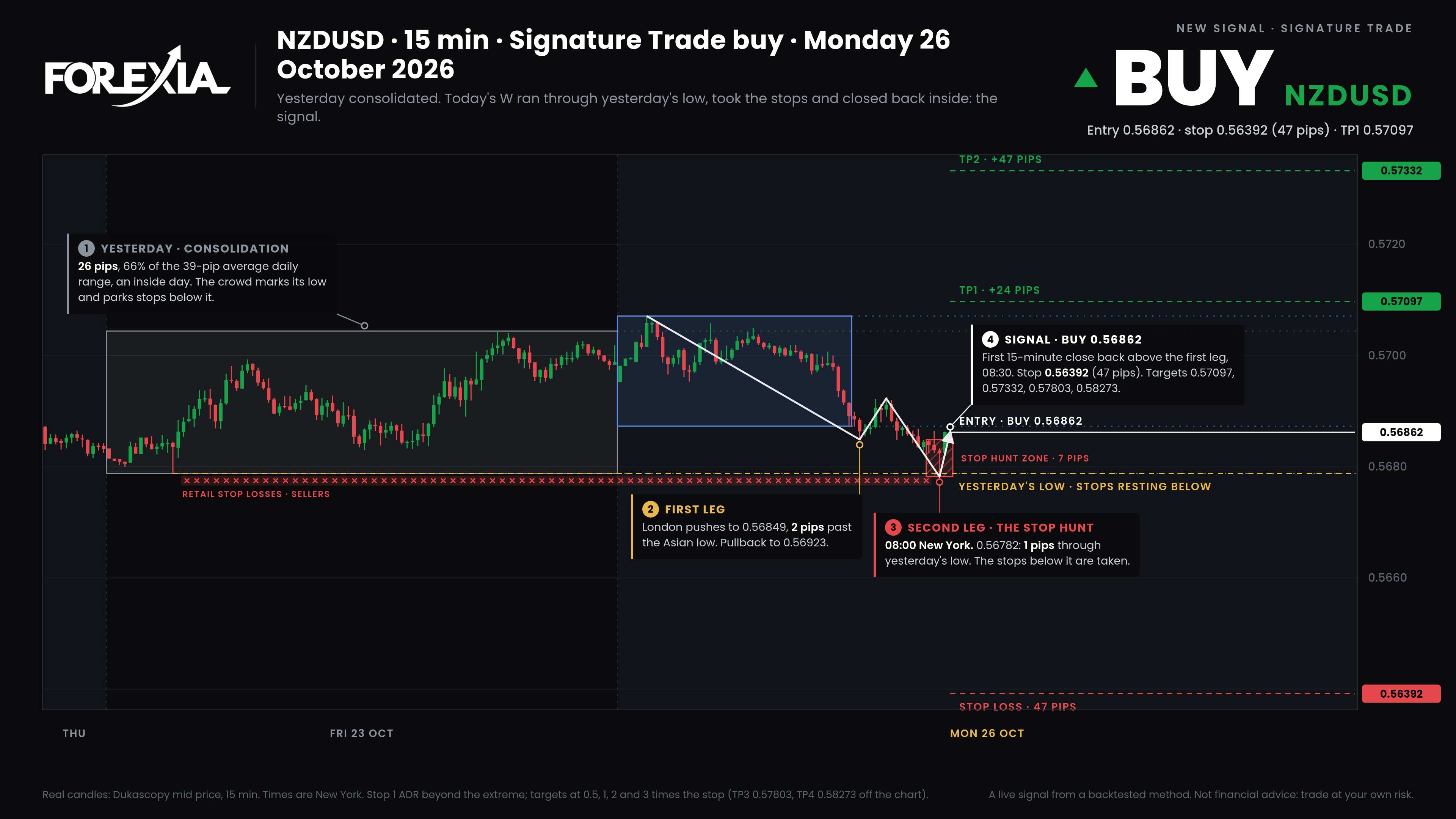
- Flagged
- 26 Oct 2026, 12:30 UTC
- Entry
- 0.56862
- Stop
- 0.56392 (47 pips)
- TP1 / TP4
- 0.57097 / 0.58273
- Group
- Free channel
The full trade log, with entry, stop, targets and a hash for each
The textbook is a drawing; every chart in the grid is real candles drawn by the signal bot; losses are included.
Frequently asked questions
What is the #SignatureTrade?
It is Forexia's name for a setup that runs over two days. Day one shows a wedge. Day two shows a clear Asian range. The window opens when price breaks the wedge and the previous day's high or low, usually at the London open. If the wedge or the range is not obvious, it is not a #SignatureTrade.
Does the bot trade the whole #SignatureTrade?
No. The live bot automates the induction and the reversal. It does not read the wedge itself: its test for the first move is that yesterday consolidated (an inside day or a small range). So the trades listed here are the Signature Trade in its mechanical form, not the full course setup with a drawn wedge.
Does the #SignatureTrade make money?
We tested the setup as a mechanical rule, with fixed conditions, and it did not make money. The name describes a pattern in the chart and who is on each side of it. It is not a promise that the break turns.
Are the losing trades listed?
Yes. The trade log lists every Signature Trade the free channel sent, with its levels, losses as well as wins, as counts and not as a win rate.